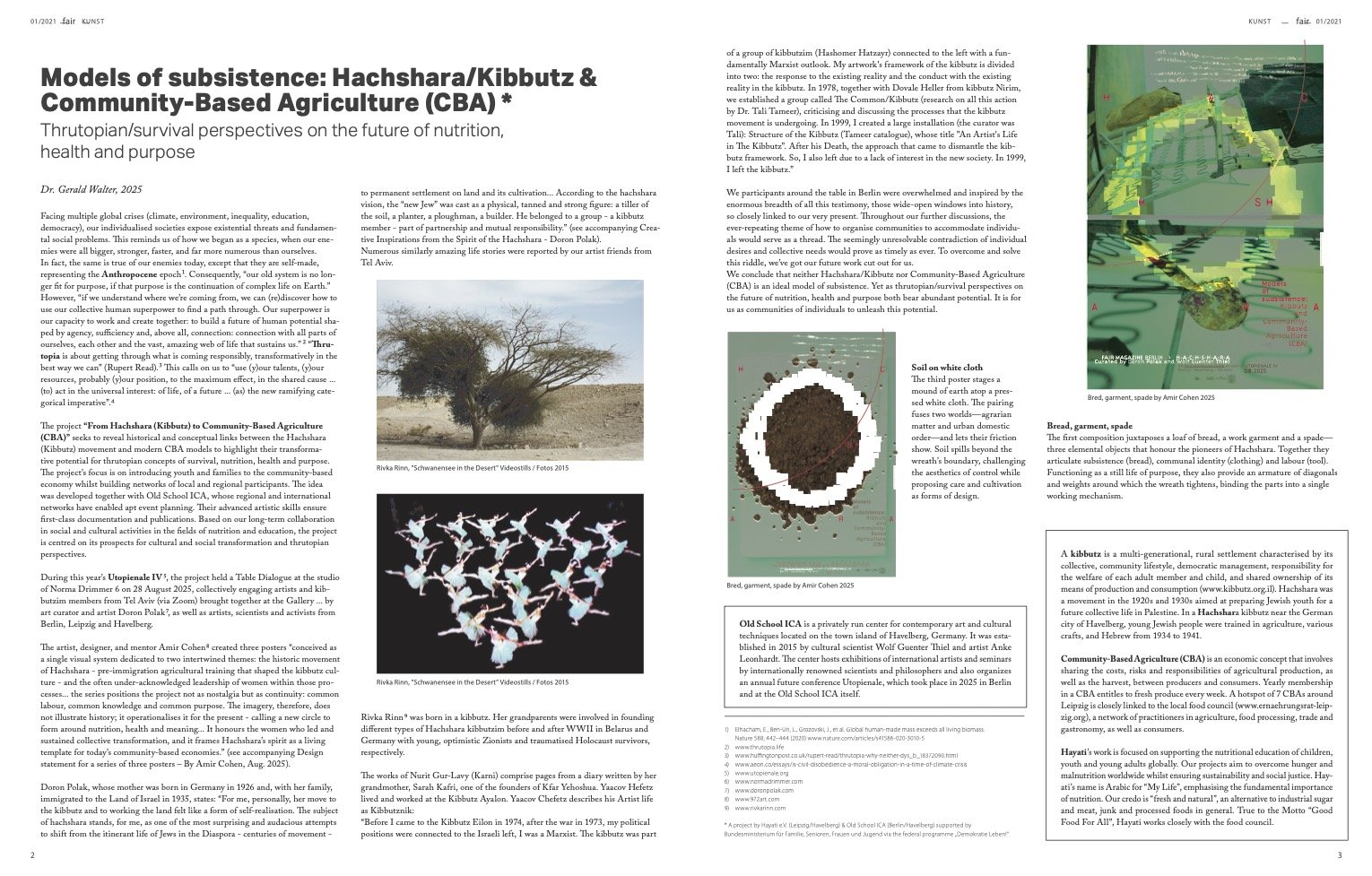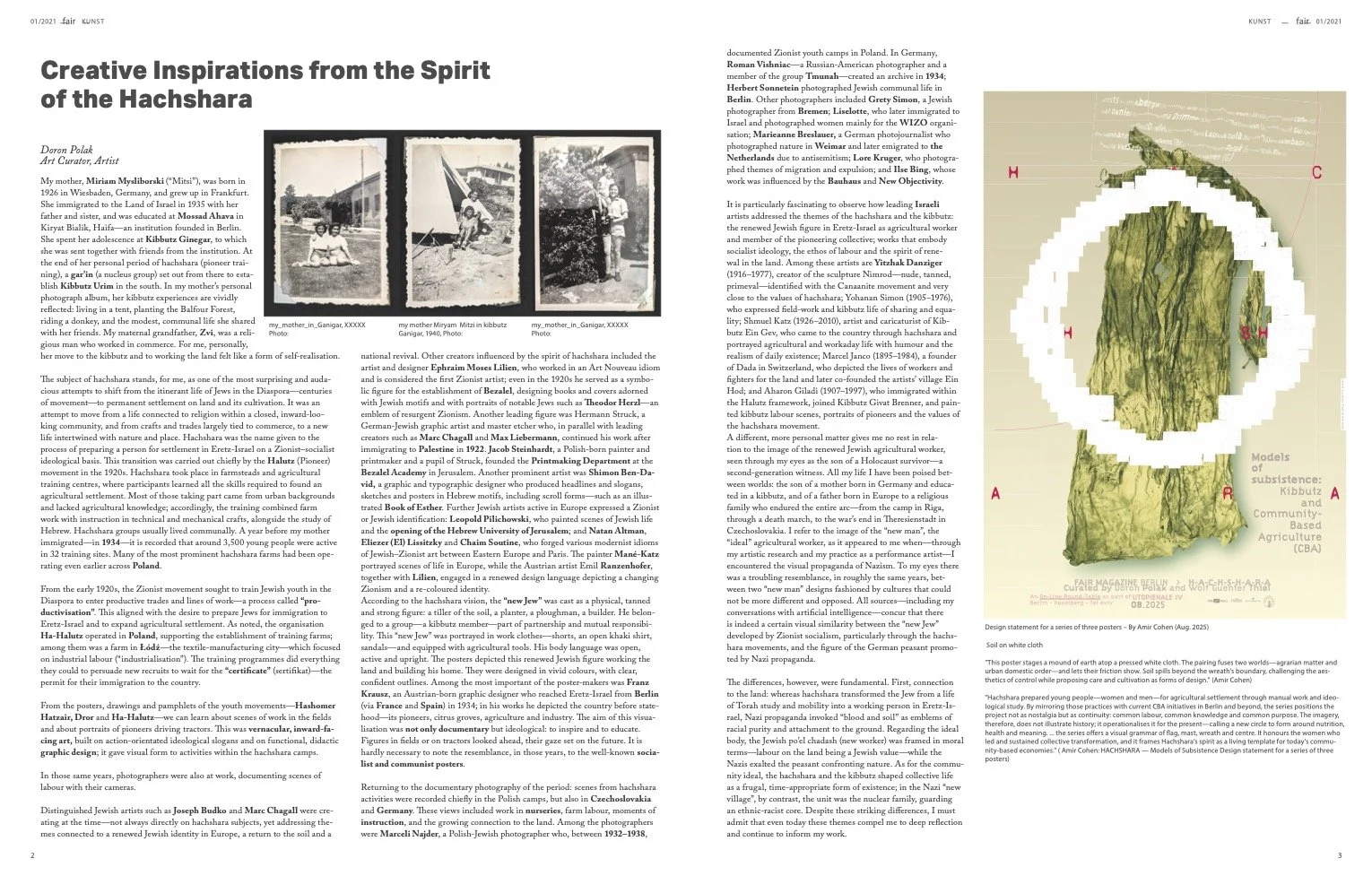
HACHSHARA — Models of Subsistence
Design statement for a series of three posters – By Amir Cohen (Aug. 2025)
Amir Cohen—artist, designer, and mentor—pursues a multi-disciplinary visual inquiry; the concept of “the Other” is central to his practice. Through his ongoing Home–Land–Body–Scape framework he explores habitat and nomadism, translating insights into action.
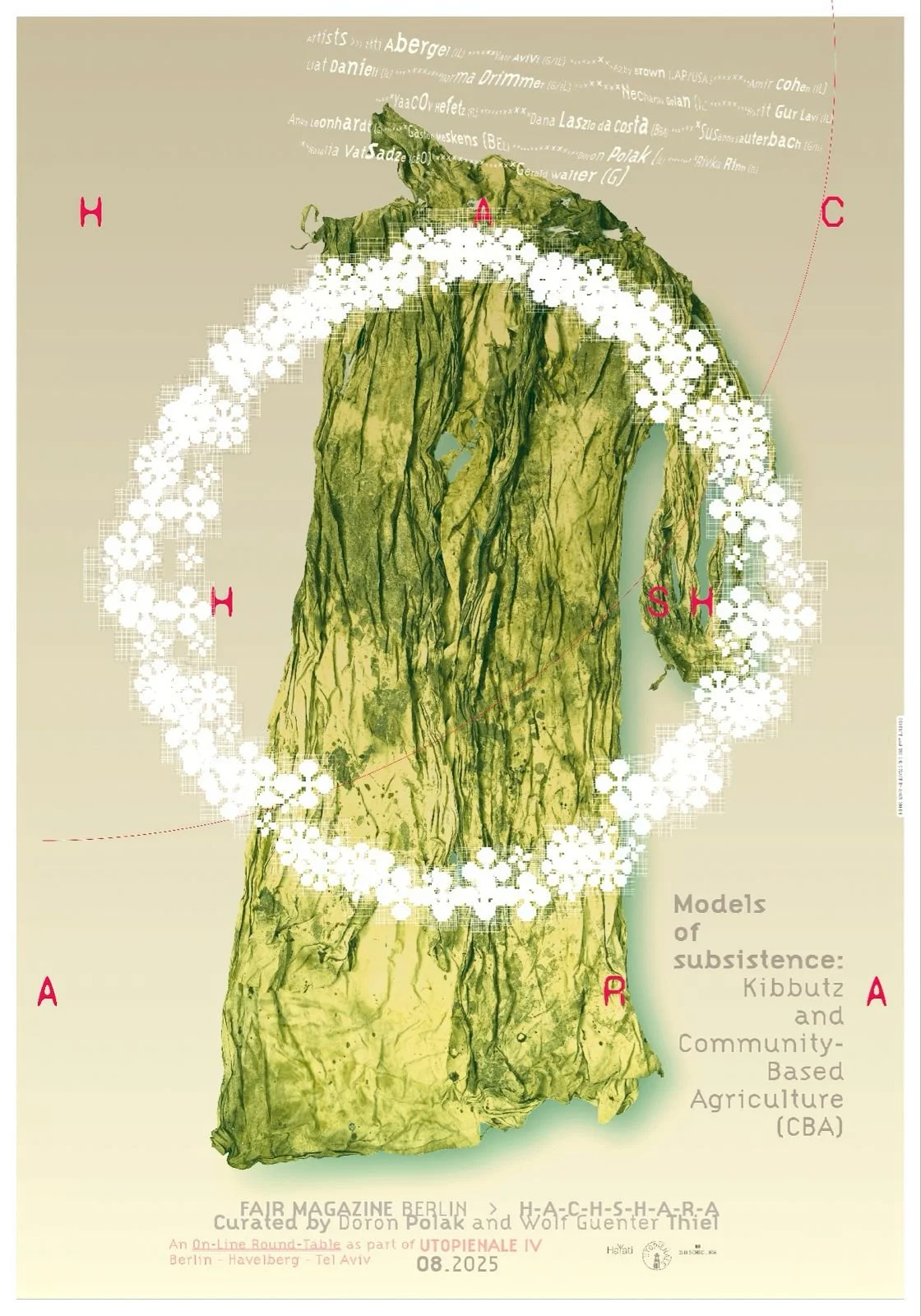
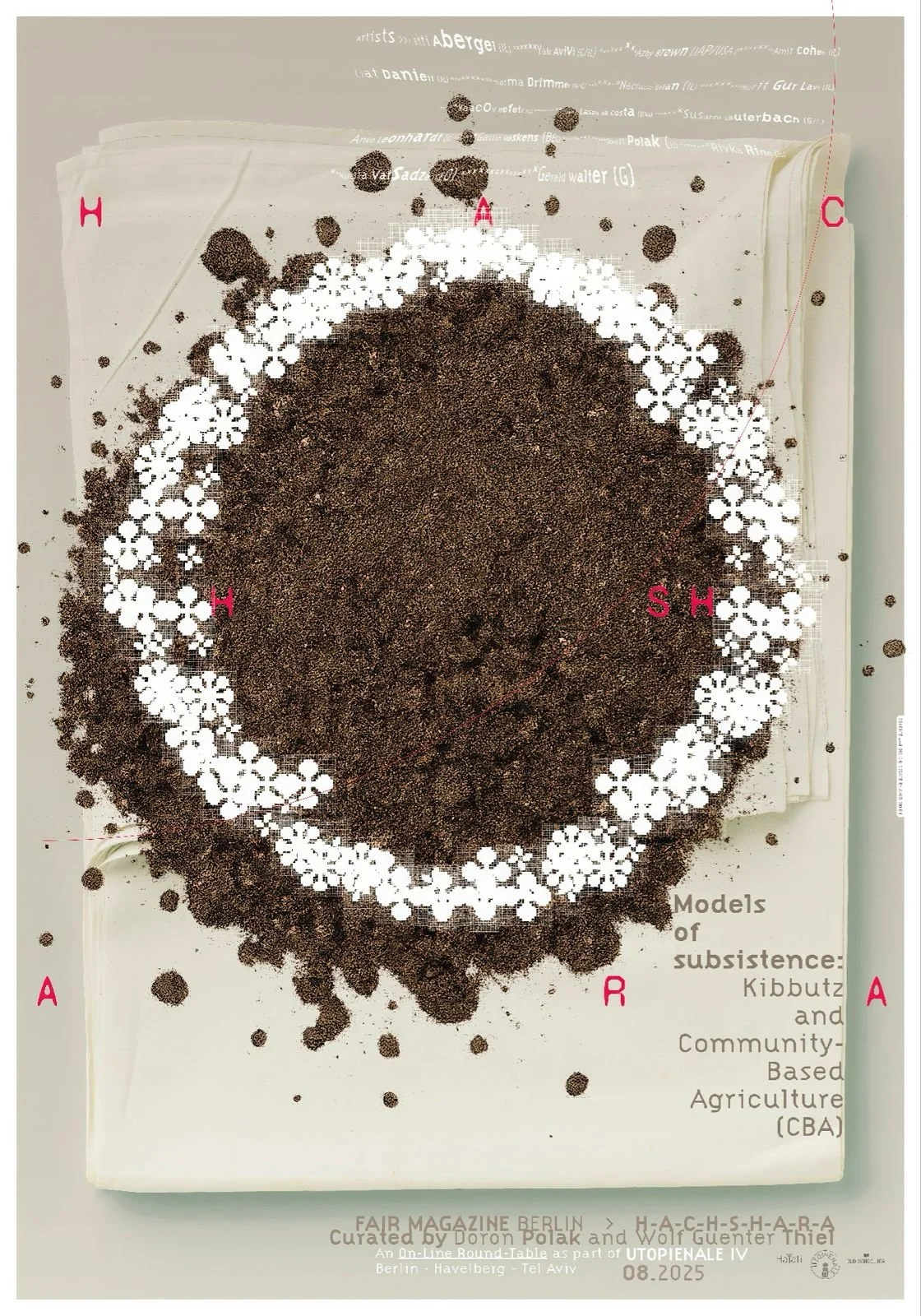
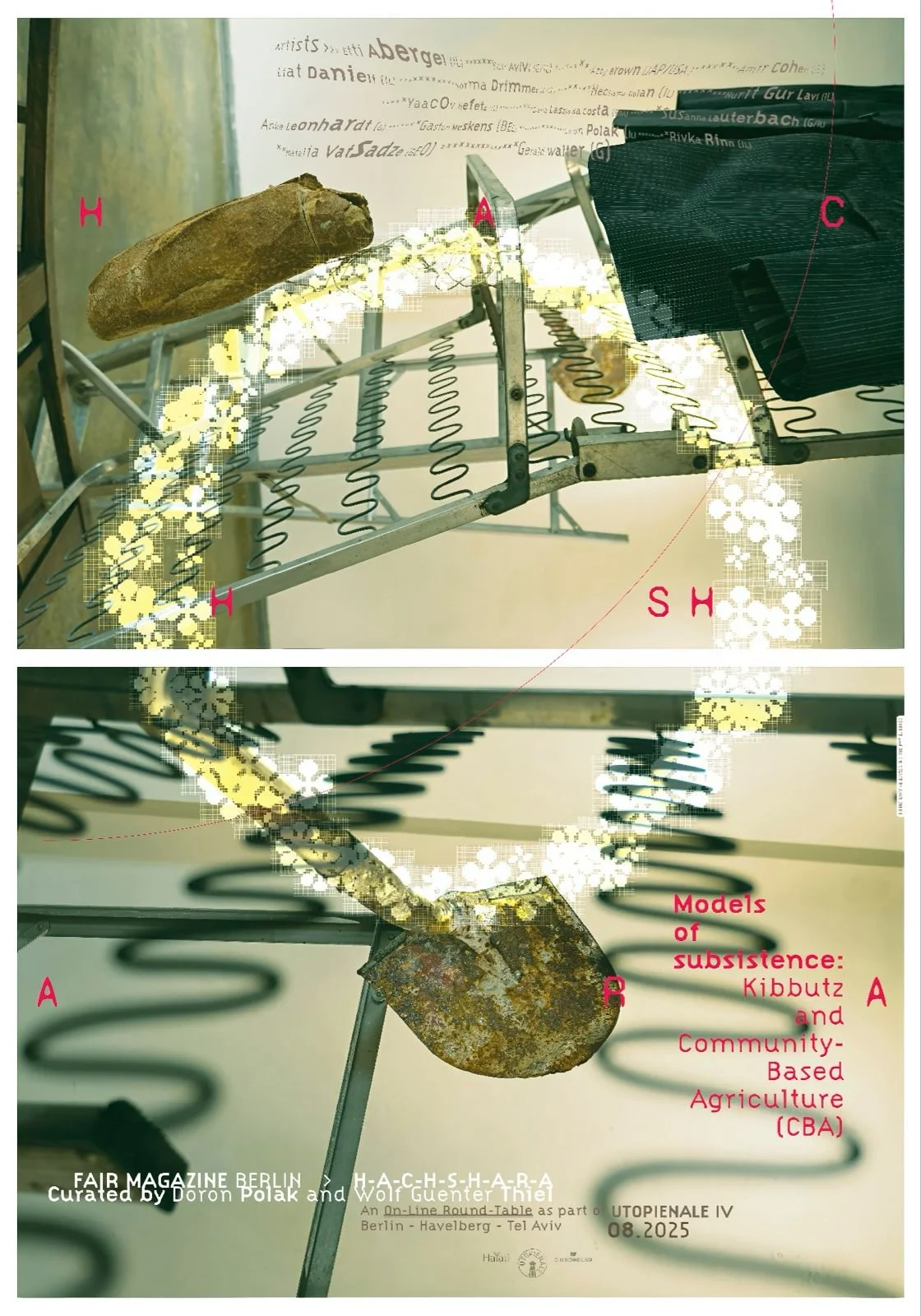
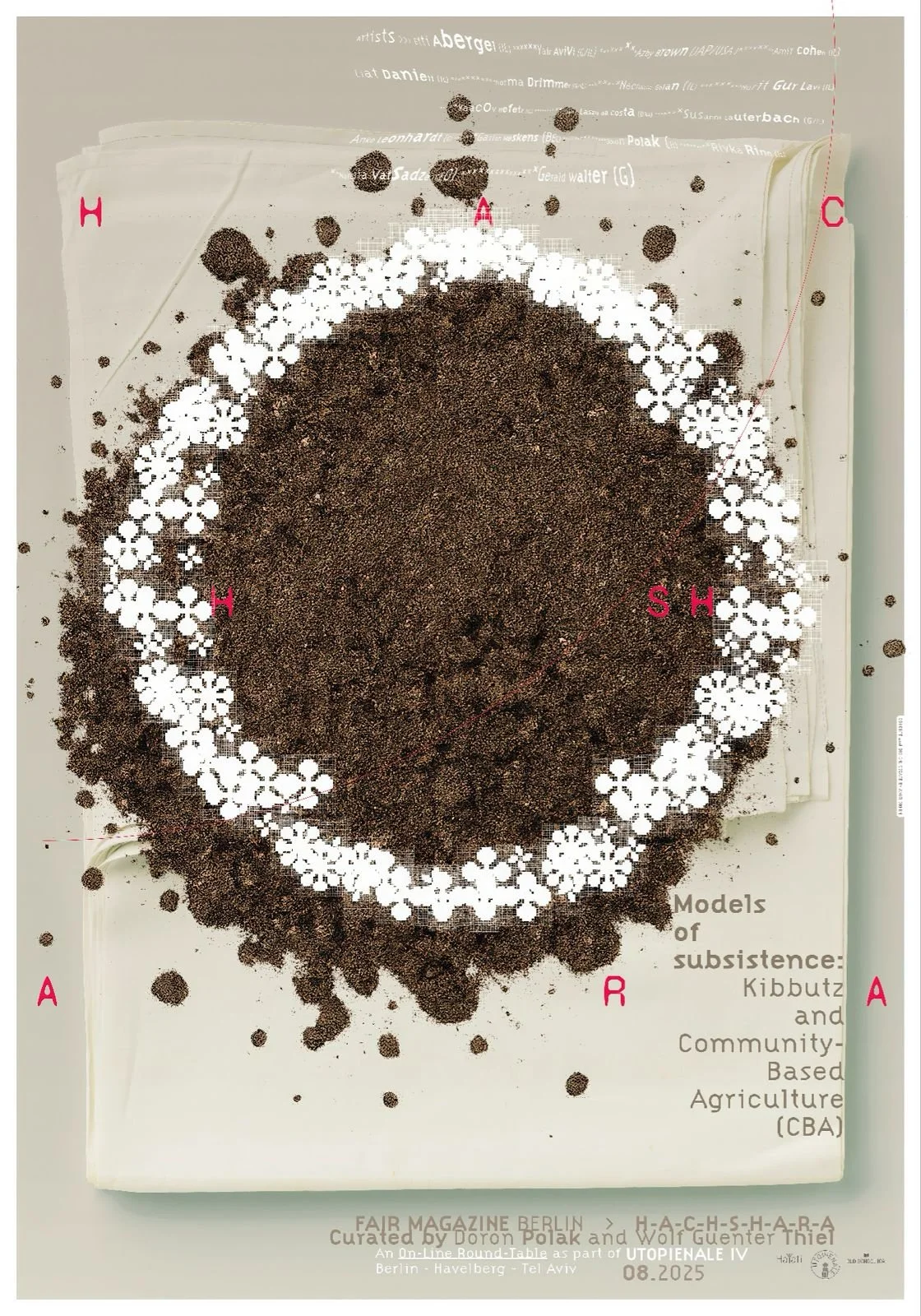
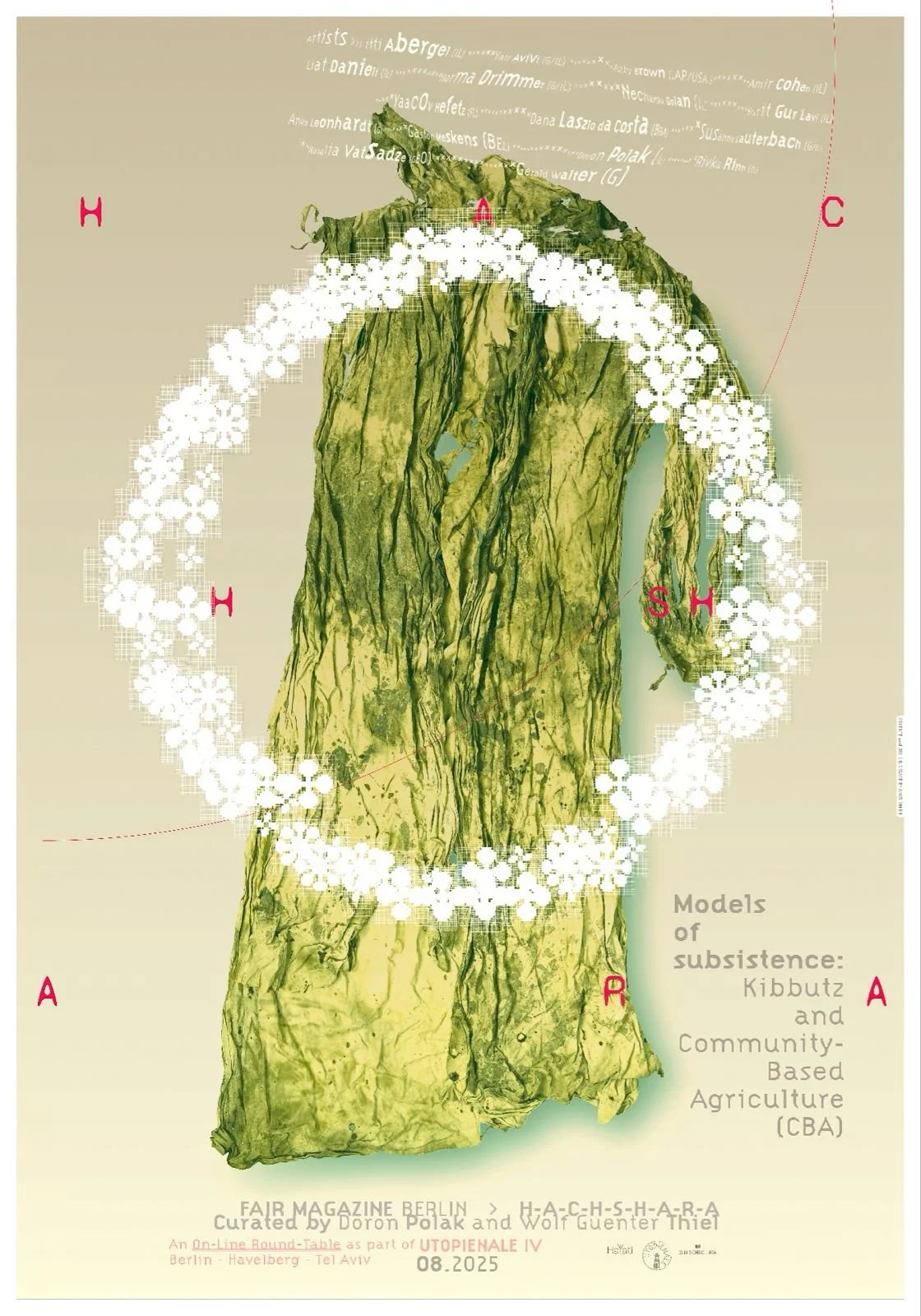
This poster series is conceived as a single visual system dedicated to two intertwined themes: the historic movement of Hachshara—pre-immigration agricultural training that shaped kibbutz culture—and the often-underacknowledged leadership of women within those processes. The series is published in Berlin by FAIR and accompanies a simultaneous round-table in Berlin, Havelberg and Tel Aviv, which links Hachshara’s legacy to contemporary models of community-based agriculture (CBA).
Visual architecture
Across all three posters, a typographic field runs along the top in undulating lines. The wave reads as a flag in the wind, a collective banner under which artists and activists advance—pioneers at the head of the column. A slender curved line sweeps down through each composition, a segment calculated from the golden ratio that operates as an implied mast and directional vector, guiding the eye from the banner to the centre.
At the core of each poster sits a white typographic wreath (ring form) constructed from modular typographic flowers. It is burned into the underlying image so that image and wreath become one surface. The wreath is a double sign: it recalls the historical training groups—the kibbutz collective—and it frames a present-day circle of community, the contemporary commons. Its ornamental vocabulary is quoted from the embroidered motifs of the so-called “Russian shirt” of the 1920s–30s (a V-neck floral trim), re-coded here as pixels and type. The magenta letters H-A-C-H-S-H-A-R-A orbit the composition like cardinal points, spelling the movement and asserting its geography.
The three centres
Each poster is anchored by a distinct central image that carries a conceptual role and a compositional one.
Bread, garment, spade
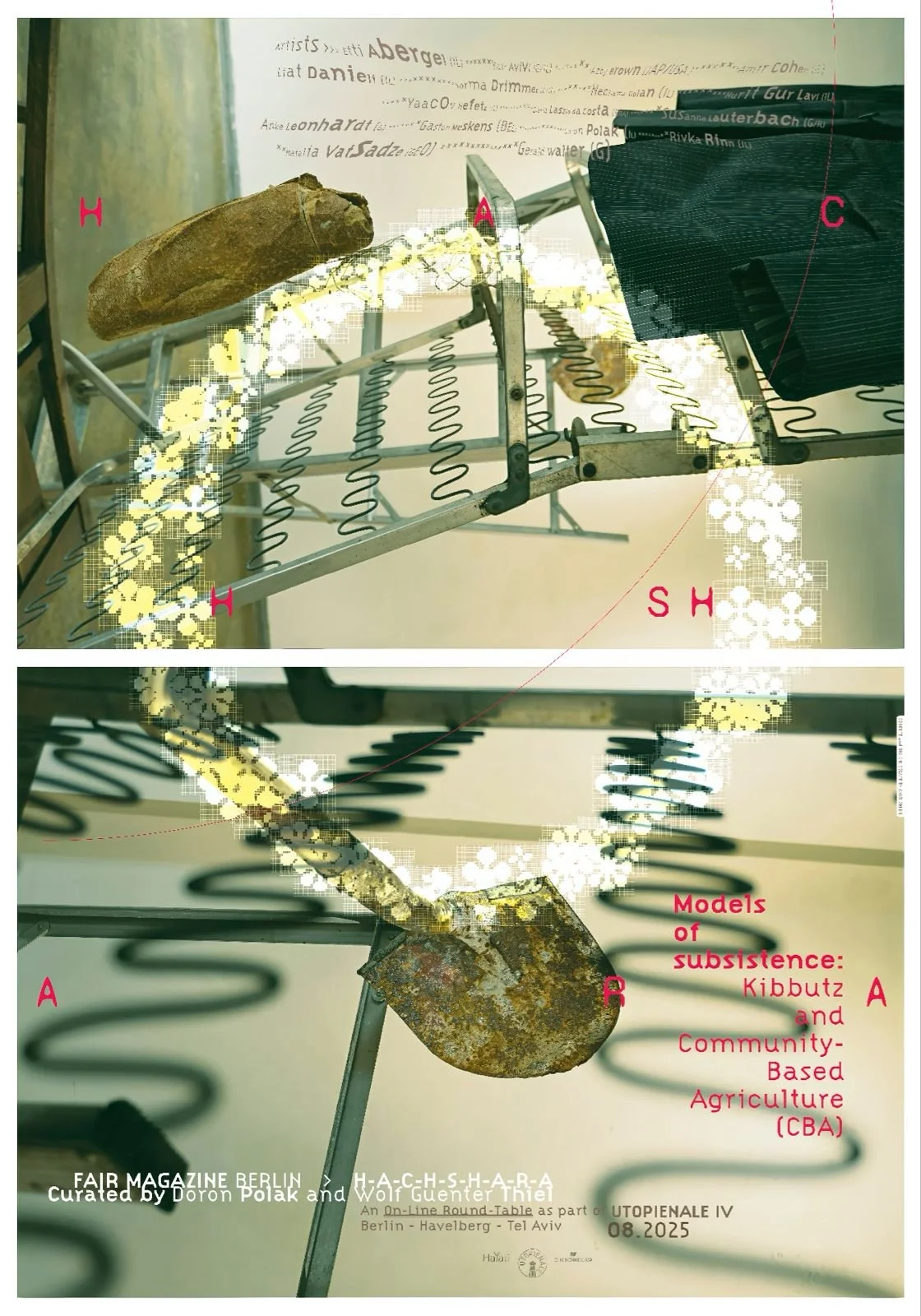
The first composition juxtaposes a loaf of bread, a work garment and a spade—three elemental objects that honour the pioneers of Hachshara. Together they articulate subsistence (bread), communal identity (clothing) and labour (tool). Functioning as a still life of purpose, they also provide an armature of diagonals and weights around which the wreath tightens, binding the parts into a single working mechanism.The yellow dress
At the centre of the second poster is a dress—deliberately suspended between the practical and the abstract. Its yellow tone resonates with sun, wheat and endurance. The dress insists on women’s agency—not as an afterthought but as the structural protagonist of the image. Here the wreath reads as both a ceremonial emblem and an assembly, foregrounding female leadership within training farms and communal life.Soil on white cloth
The third poster stages a mound of earth atop a pressed white cloth. The pairing fuses two worlds—agrarian matter and urban domestic order—and lets their friction show. Soil spills beyond the wreath’s boundary, challenging the aesthetics of control while proposing care and cultivation as forms of design.
Reading, rhythm and tone
The system is designed for serial reading: a banner that calls, a line that leads, a wreath that congregates, and a centre that anchors meaning. Palette and texture move from metal and grain to fabric and earth, tracing a passage from production to nurture. The repeated wreath unifies the set while the three centres expand the argument: subsistence is made, worn and grown.
Historical and contemporary echoes
Hachshara prepared young people—women and men—for agricultural settlement through manual work and ideological study. By mirroring those practices with current CBA initiatives in Berlin and beyond, the series positions the project not as nostalgia but as continuity: common labour, common knowledge and common purpose. The imagery, therefore, does not illustrate history; it operationalises it for the present—calling a new circle to form around nutrition, health and meaning.
In sum, the series offers a visual grammar of flag, mast, wreath and centre. It honours the women who led and sustained collective transformation, and it frames Hachshara’s spirit as a living template for today’s community-based economies. — Amir Cohen
Models of subsistence: Hachshara/Kibbutz & Community-Based Agriculture (CBA) *
- Thrutopian/survival perspectives on the future of nutrition, health and purpose -
Facing multiple global crises (climate, environment, inequality, education, democracy), our individualised societies expose existential threats and fundamental social problems. This reminds us of how we began as a species, when our enemies were all bigger, stronger, faster, and far more numerous than ourselves. In fact, the same is true of our enemies today, except that they are self-made, representing the Anthropocene epoch (1). Consequently, “our old system is no longer fit for purpose, if that purpose is the continuation of complex life on Earth.” However, “if we understand where we’re coming from, we can (re)discover how to use our collective human superpower to find a path through. Our superpower is our capacity to work and create together: to build a future of human potential shaped by agency, sufficiency and, above all, connection: connection with all parts of ourselves, each other and the vast, amazing web of life that sustains us.” (2) “Thrutopia is about getting through what is coming responsibly, transformatively in the best way we can” (Rupert Read). (3) This calls on us to “use (y)our talents, (y)our resources, probably (y)our position, to the maximum effect, in the shared cause ... (to) act in the universal interest: of life, of a future ... (as) the new ramifying categorical imperative”. (4)
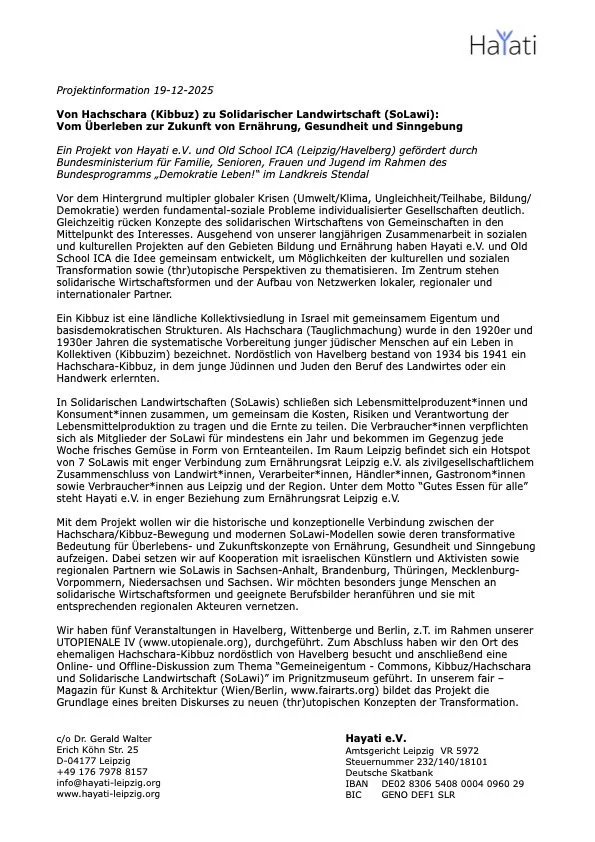
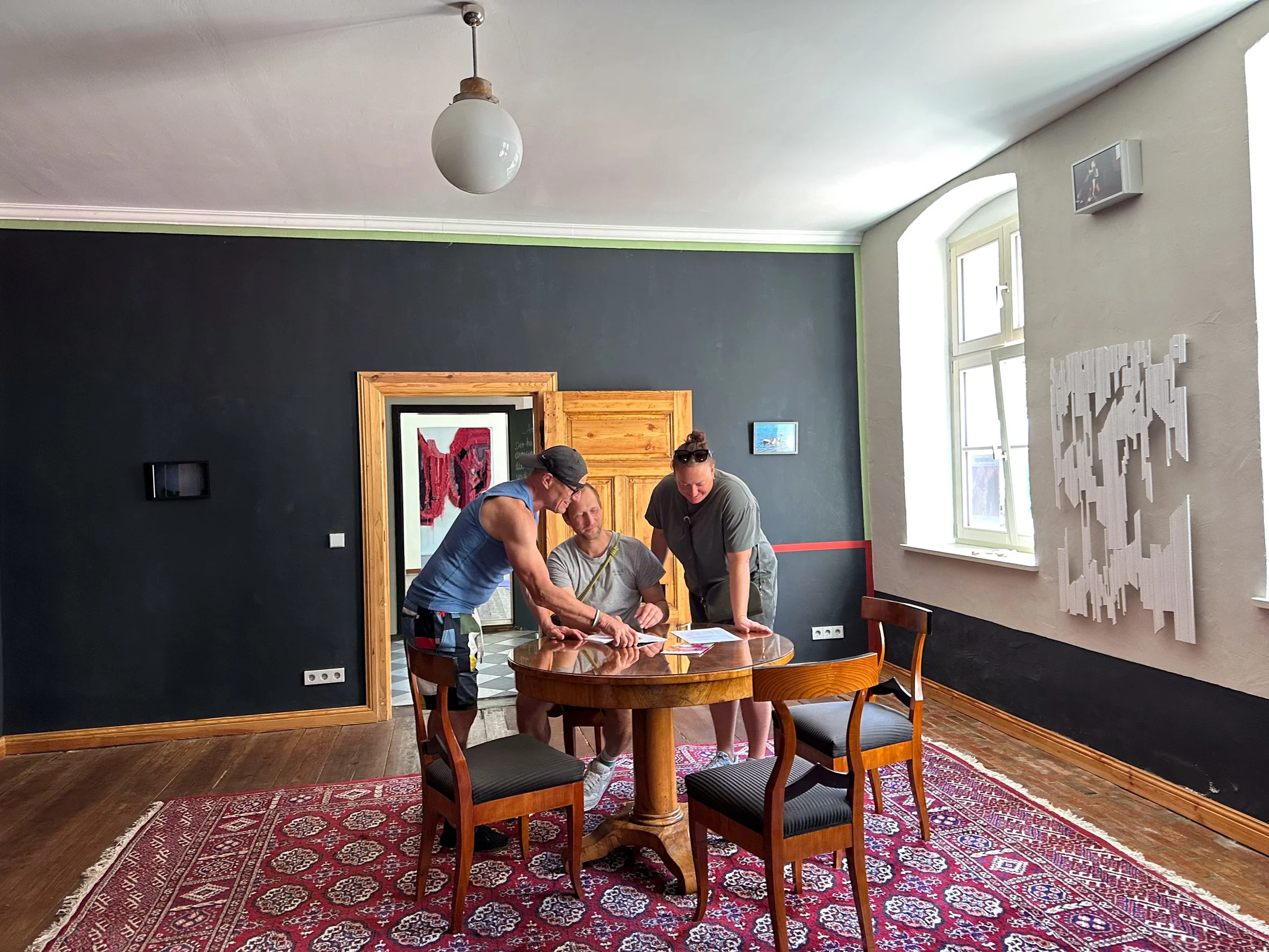
The project “From Hachshara (Kibbutz) to Community-Based Agriculture (CBA)” seeks to reveal historical and conceptual links between the Hachshara (Kibbutz) movement and modern CBA models, highlighting their transformative potential for thrutopian concepts of survival, nutrition, health, and purpose. The project’s focus is on introducing youth and families to the community-based economy whilst building networks of local and regional participants. The idea was developed in collaboration with Old School ICA, whose regional and international networks have enabled effective event planning. Their advanced artistic skills ensure first-class documentation and publications. Based on our long-term collaboration in social and cultural activities in the fields of nutrition and education, the project is centred on its prospects for cultural and social transformation and thrutopian perspectives. We work with schools, various NGOs, regional CBAs, and the Prignitz-Museum am Dom Havelberg. Further to Hayati’s previous “Kinderprojekt Essbare Stadt Havelberg” (2021) and Old School ICA’s “Zukunft Gestalten” (2024), we keep working for a better world together.
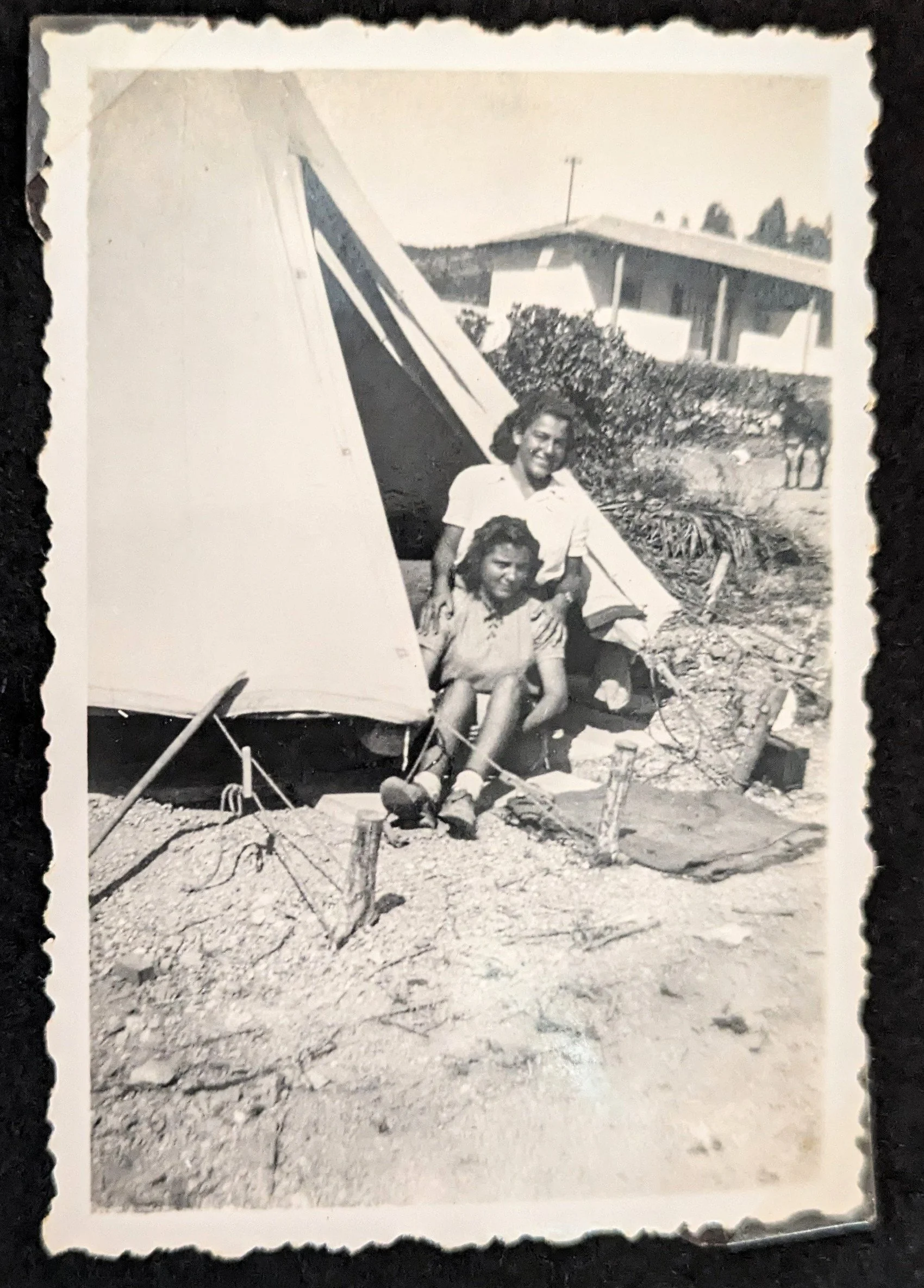
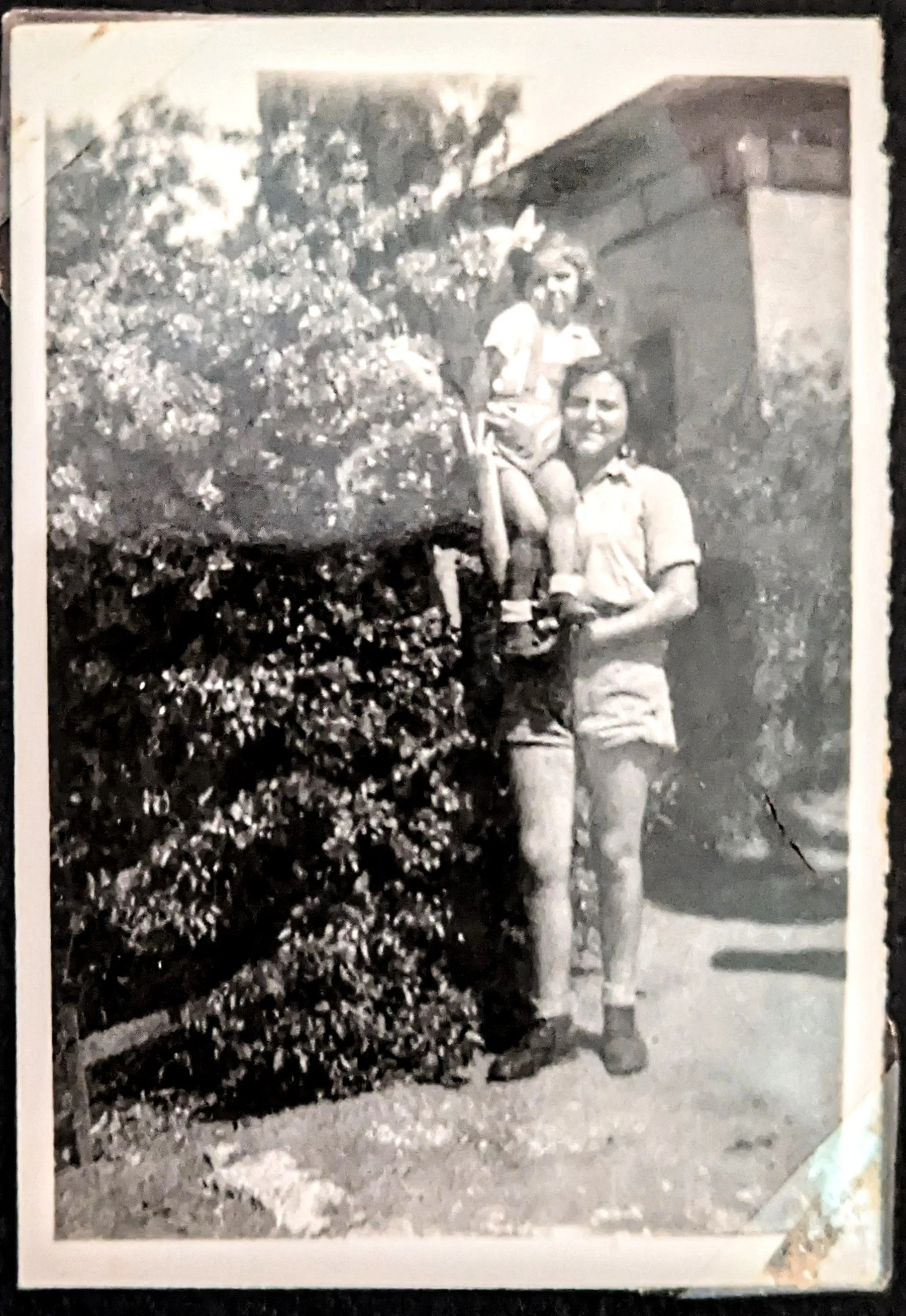
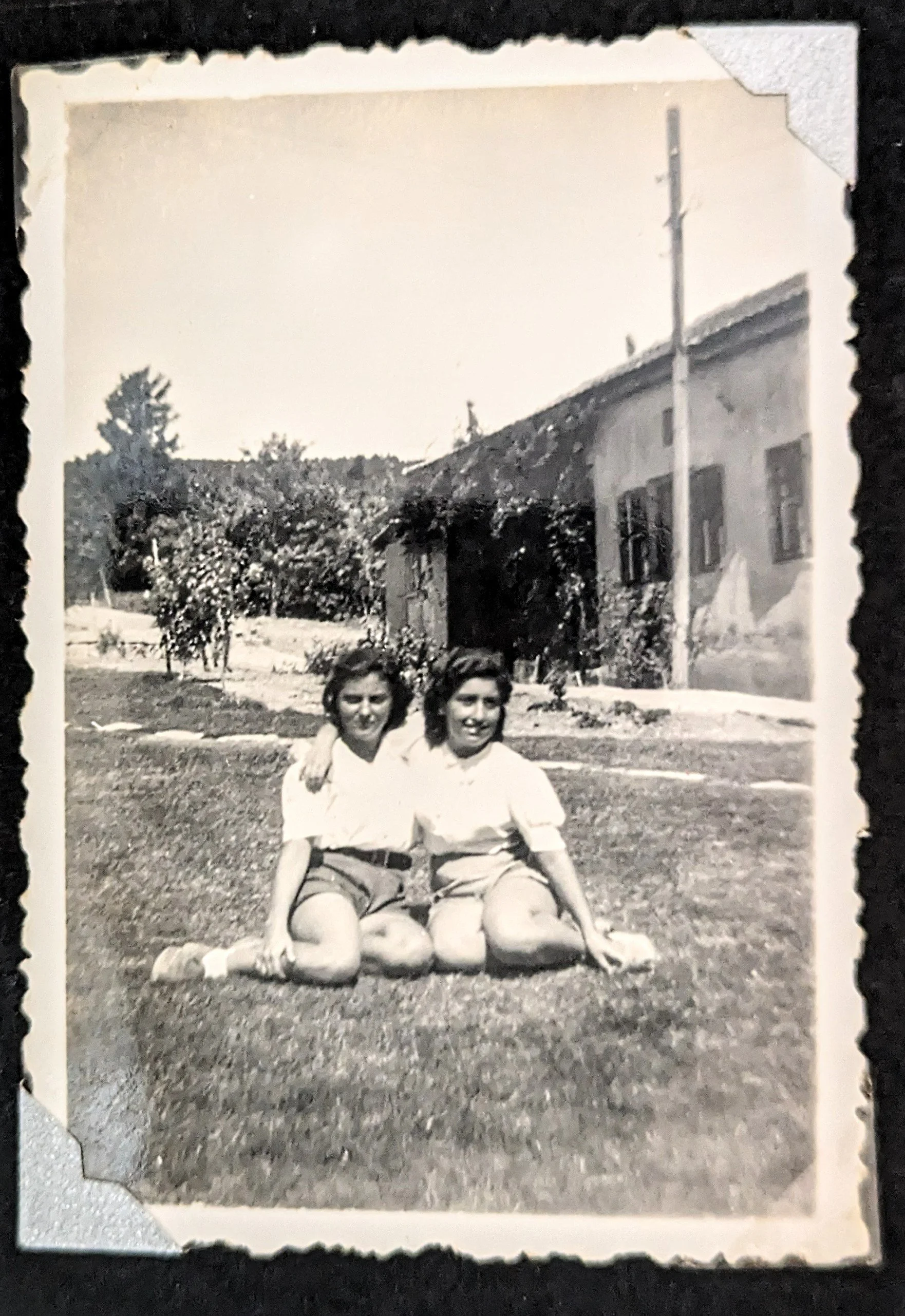
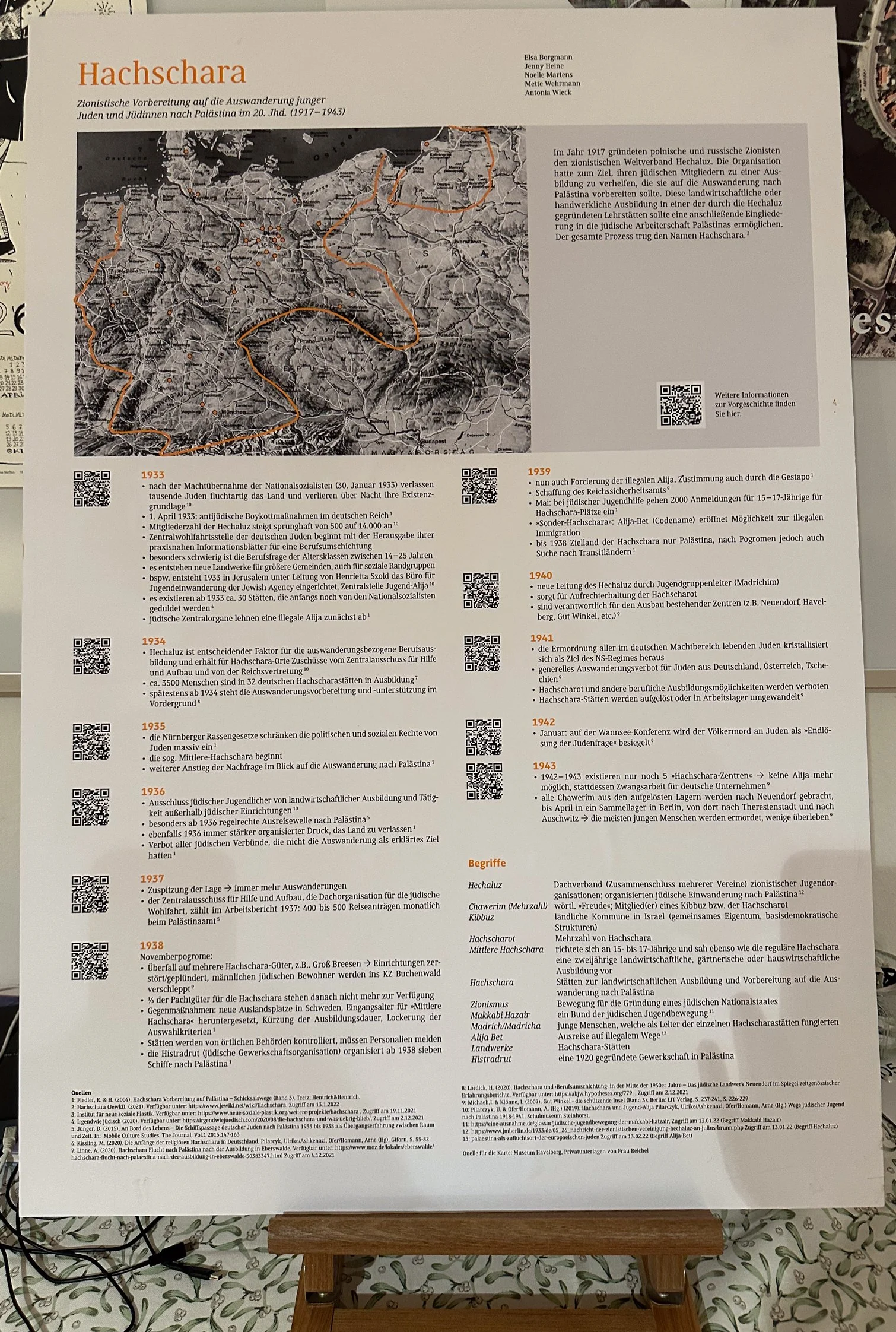
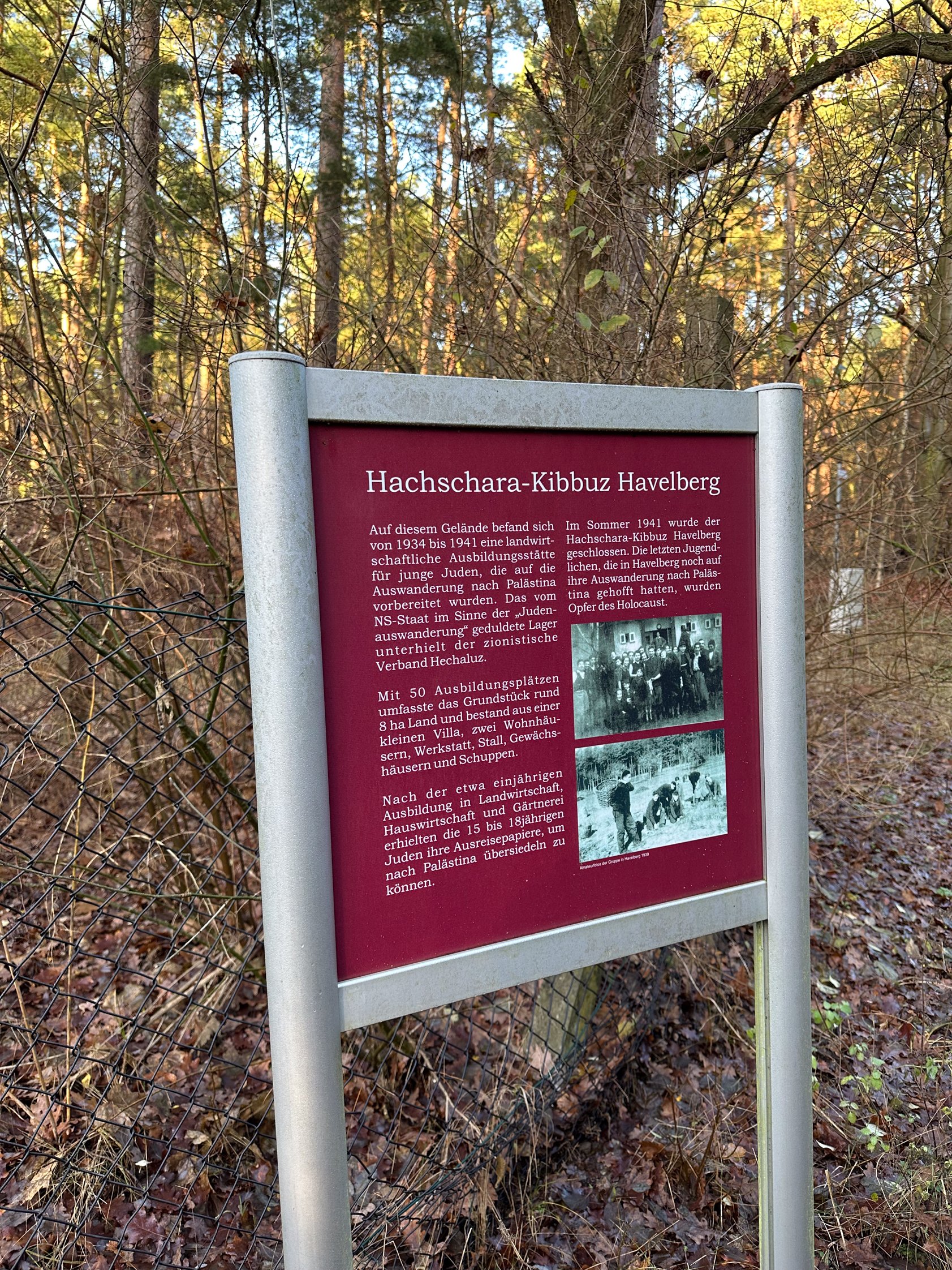
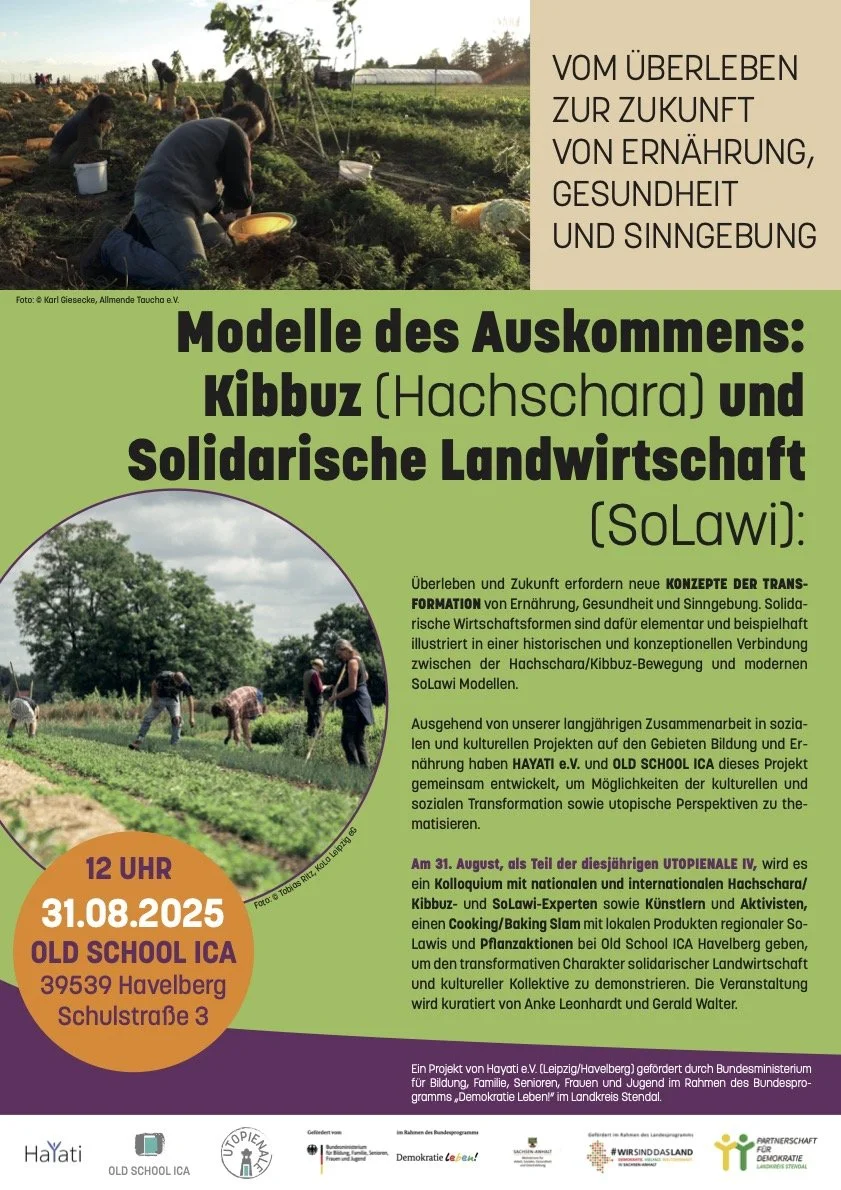
A kibbutz is a multi-generational, rural settlement characterised by its collective, community lifestyle, democratic management, responsibility for the welfare of each adult member and child, and shared ownership of its means of production and consumption (www.kibbutz.org.il). Hachschara was a movement in the 1920s and 1930s aimed at preparing Jewish youth for a future collective life in Palestine. In a Hachschara kibbutz near the German city of Havelberg, young Jewish people were trained in agriculture, various crafts, and Hebrew from 1934 to 1941.
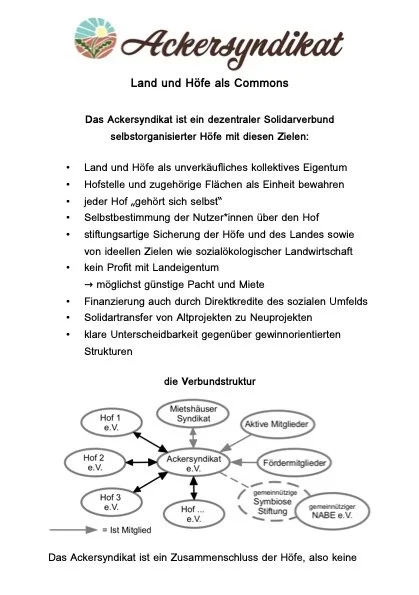
Community-Based Agriculture (CBA) is an economic concept that involves sharing the costs, risks and responsibilities of agricultural production, as well as the harvest, between producers and consumers. Yearly membership in a CBA entitles to fresh produce every week. A hotspot of seven CBAs around Leipzig is closely linked to the local food council (Ernährungsrat Leipzig e.V.), a network of agriculturists, practitioners in food processing, trade and gastronomy, as well as consumers.
True to the Motto “Good Food For All”, Hayati e.V. is closely linked to the food council (board membership of Dr. Gerald Walter). Hayati’s work is focused on supporting the nutrition and education of children, youth and young adults globally. Our projects aim to overcome hunger and malnutrition while ensuring sustainability and social justice. Hayati’s name is Arabic for “My Life”, emphasising the fundamental importance of nutrition. Our credo is “fresh and natural”, an alternative to industrial sugar and meat, junk and processed foods in general.
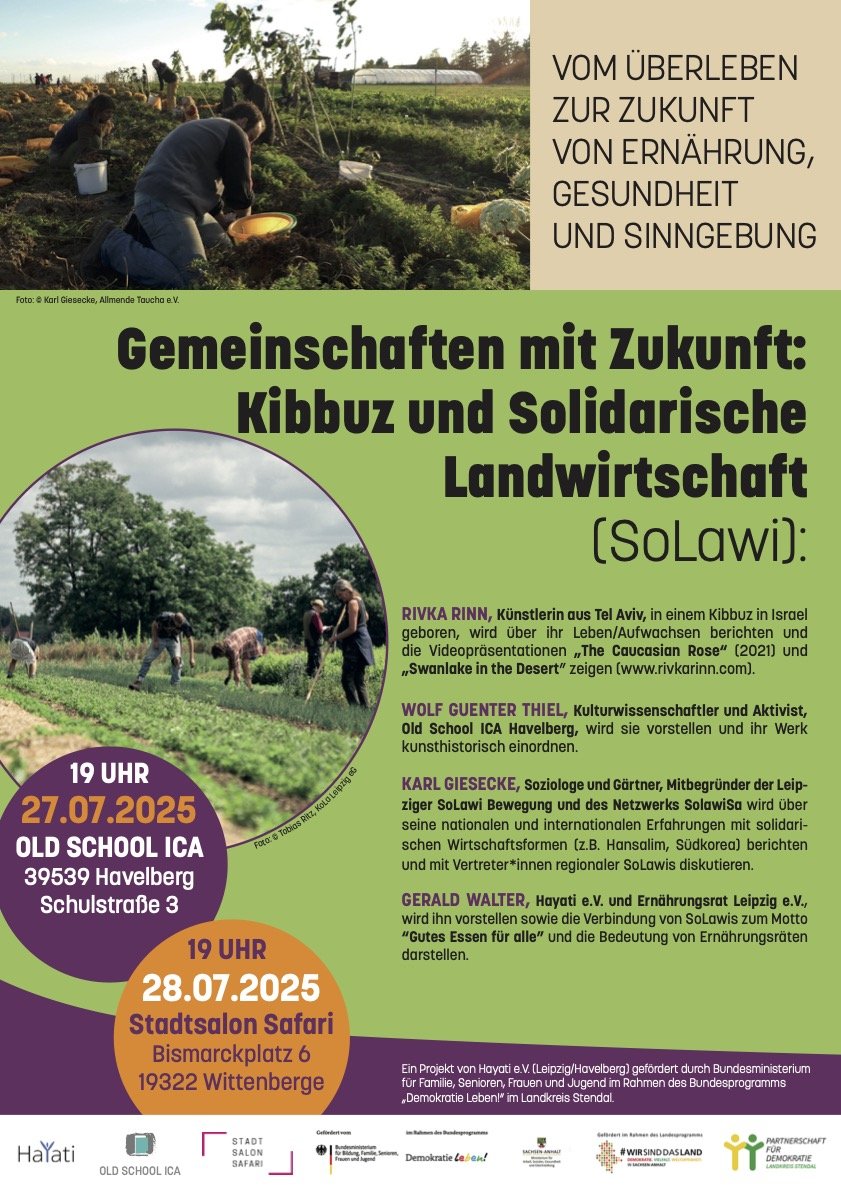
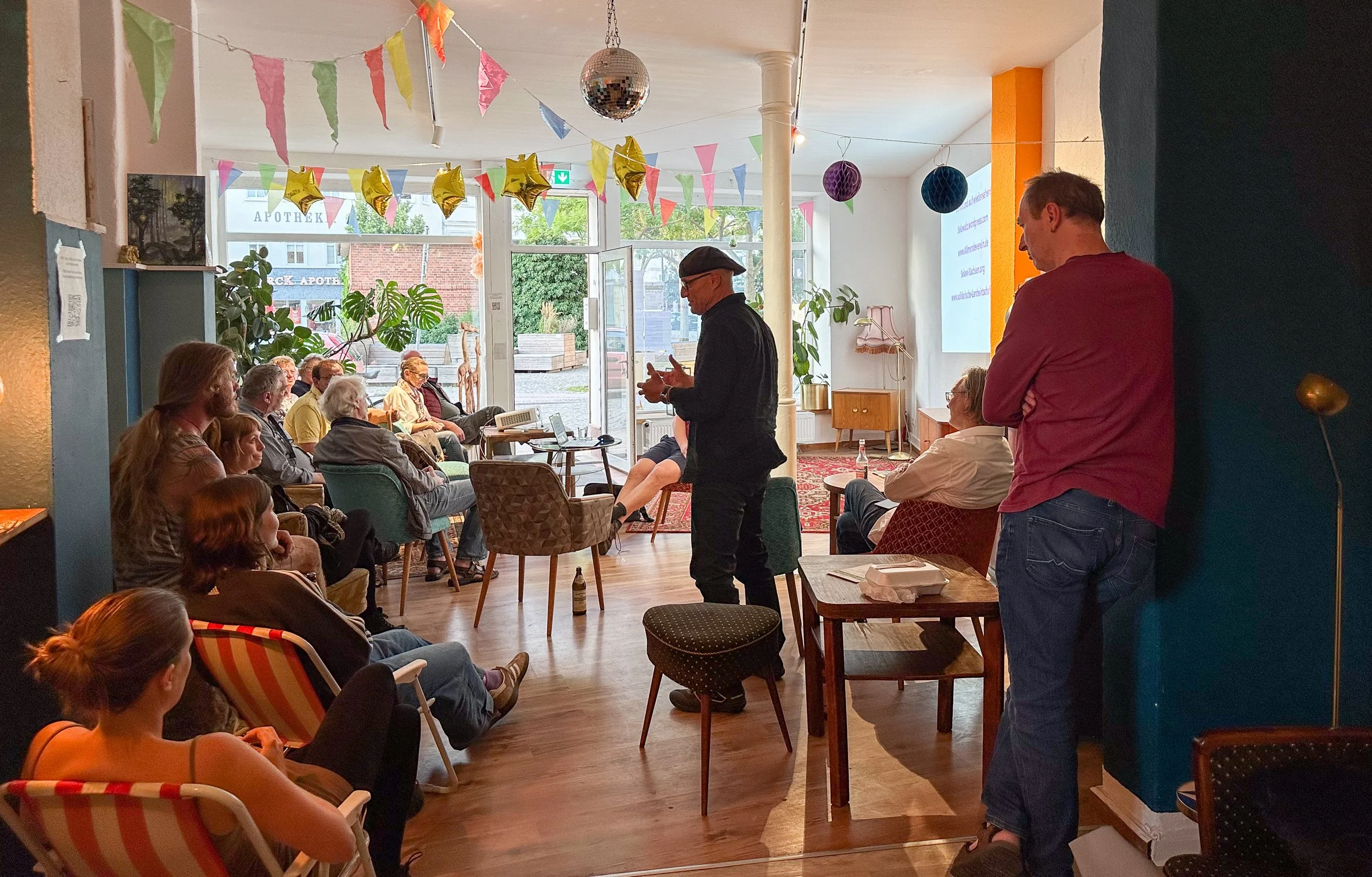
At events in Havelberg and Wittenberge, the Israeli artist Rivka Rinn, who was born in a kibbutz, talked about her upbringing and her family story. Her grandparents were involved in founding different types of Hachschara kibbutzim before and after WWII in Belarus and Germany with young, optimistic Zionists and traumatised Holocaust survivors, respectively.
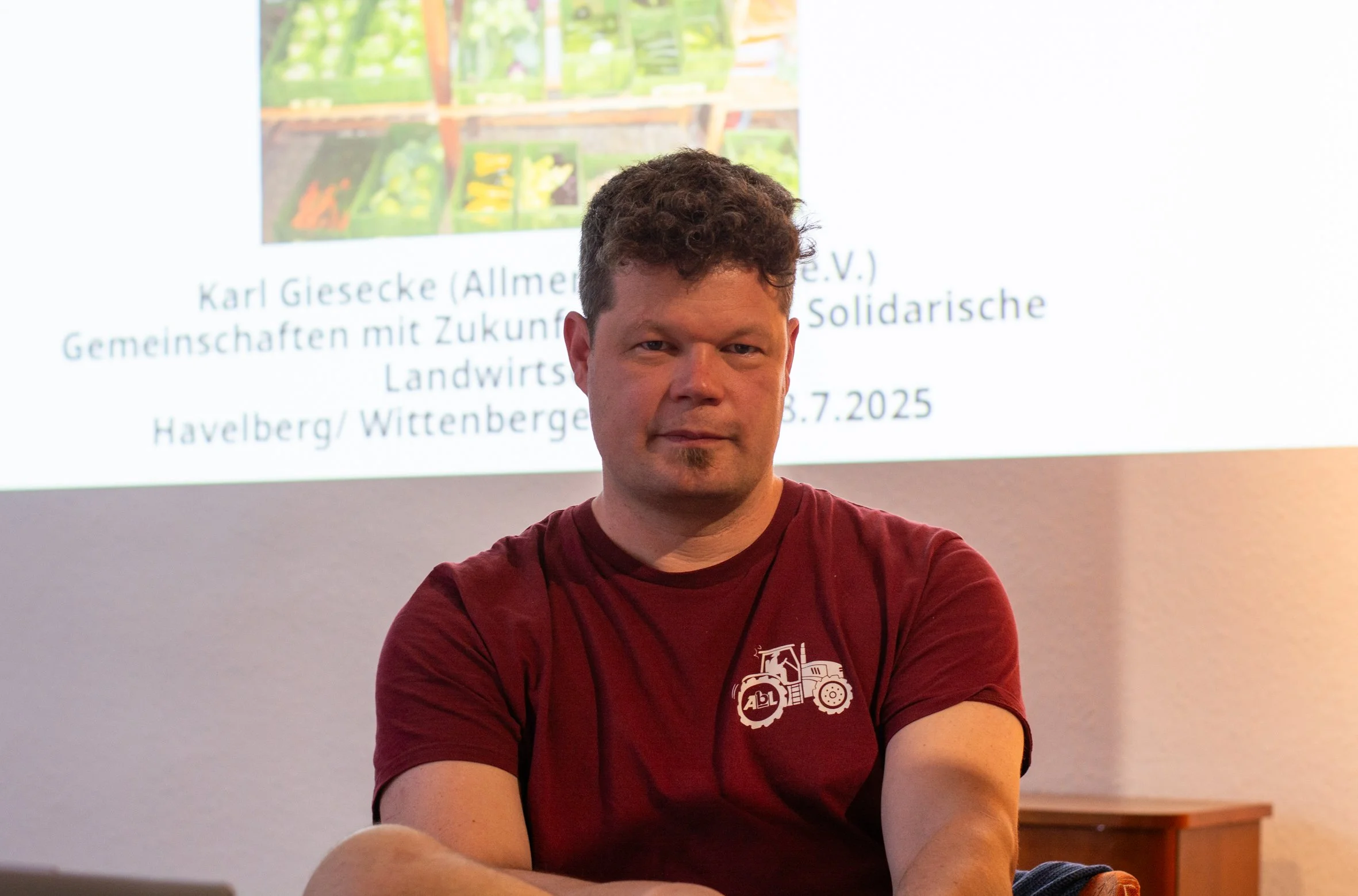
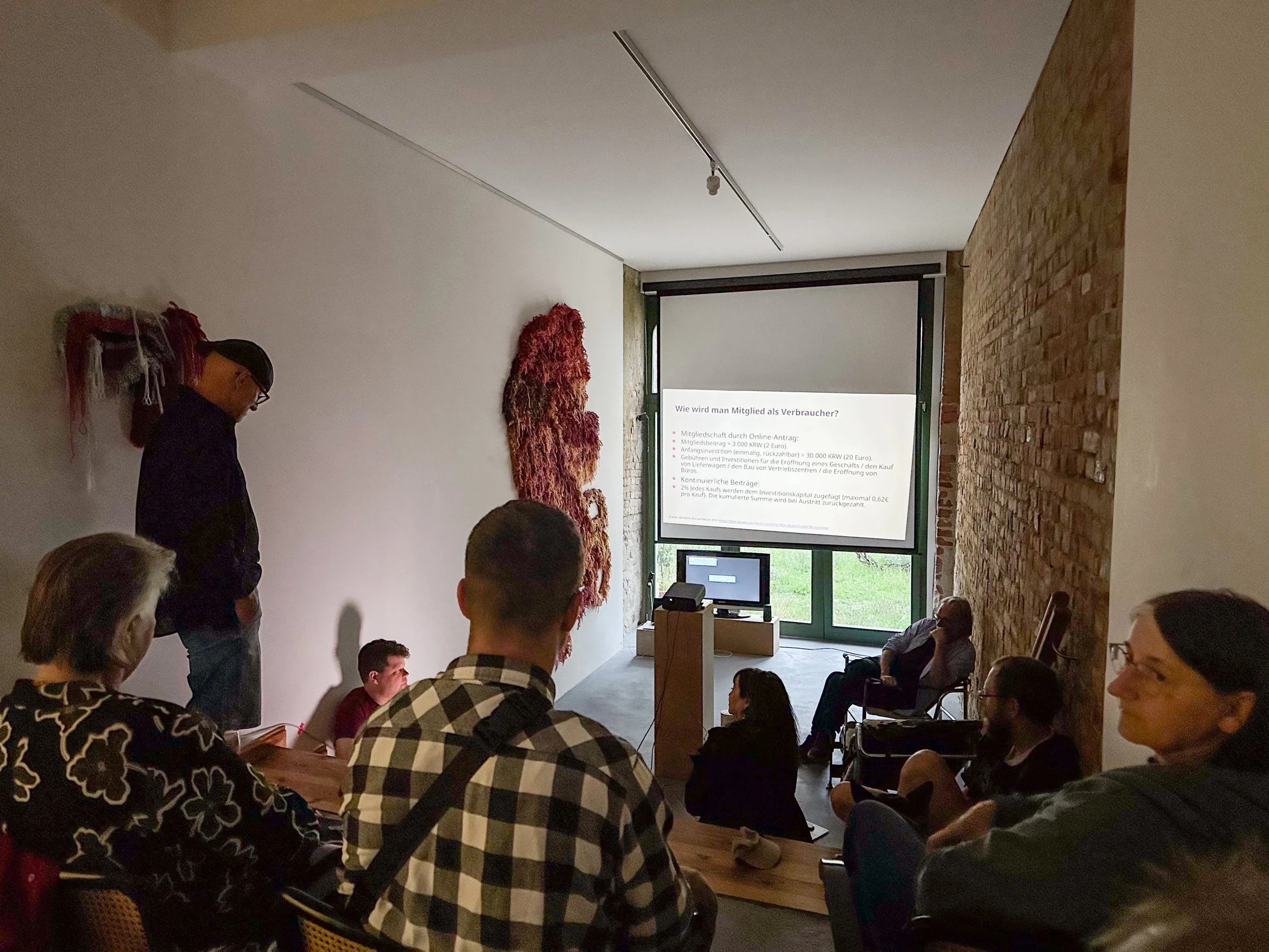
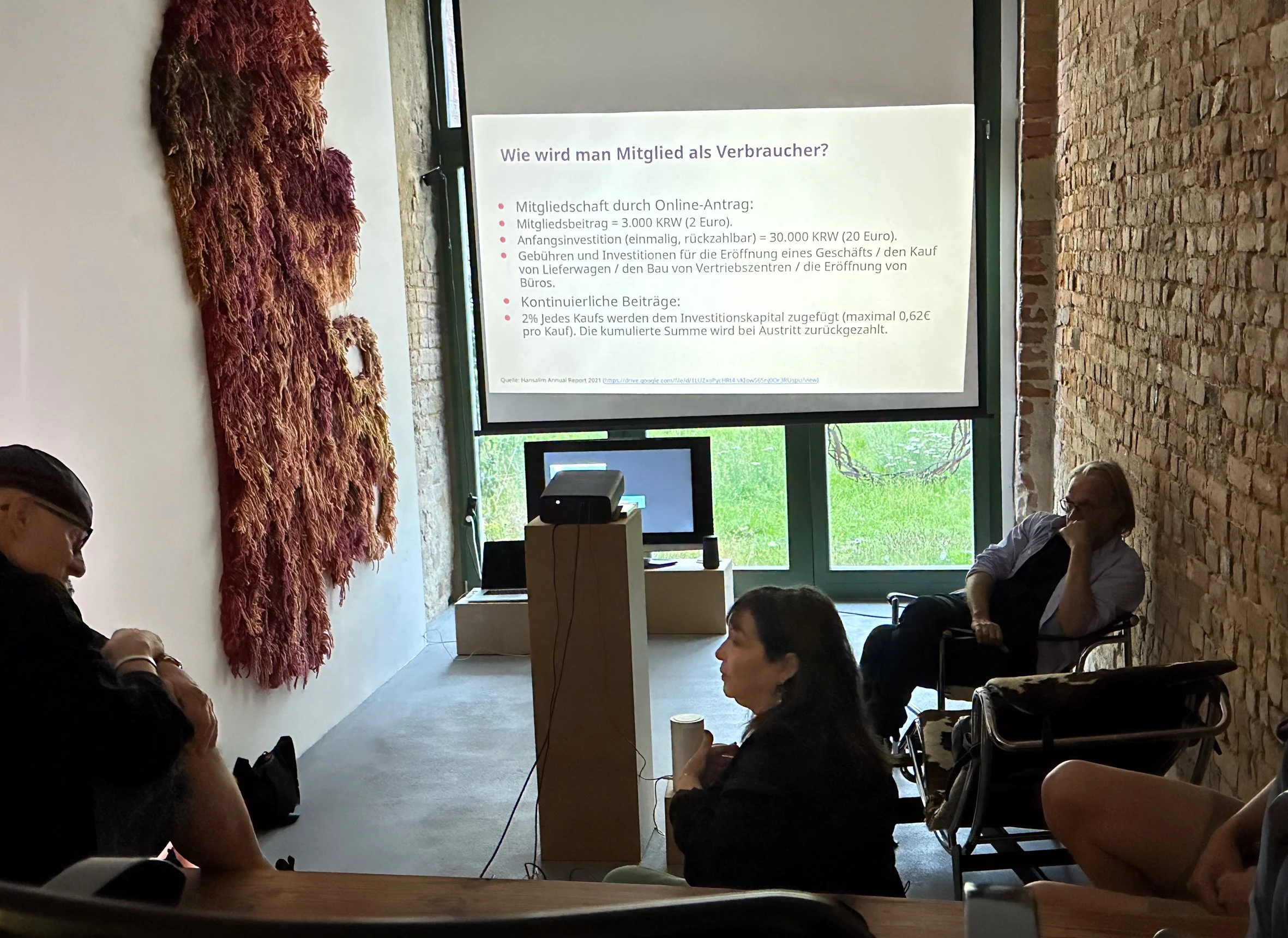
Karl Giesecke, joint founder of Leipzig’s CBA movement and the network SoLawiSa, reflected on his experience with national and international exhibits of the community-based economy (e.g. Hansalim, South Korea) and interacted with representatives of regional CBAs.
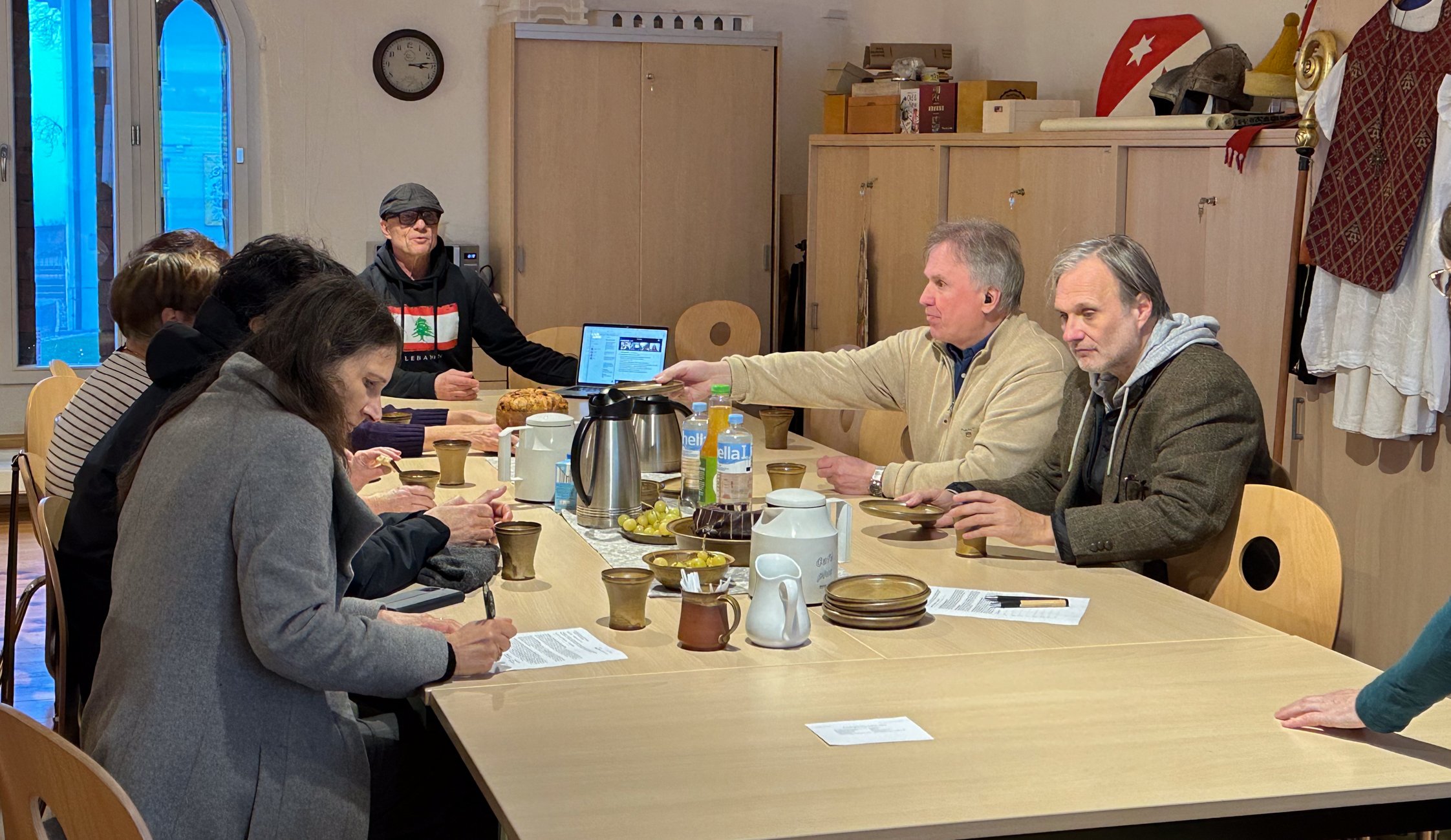
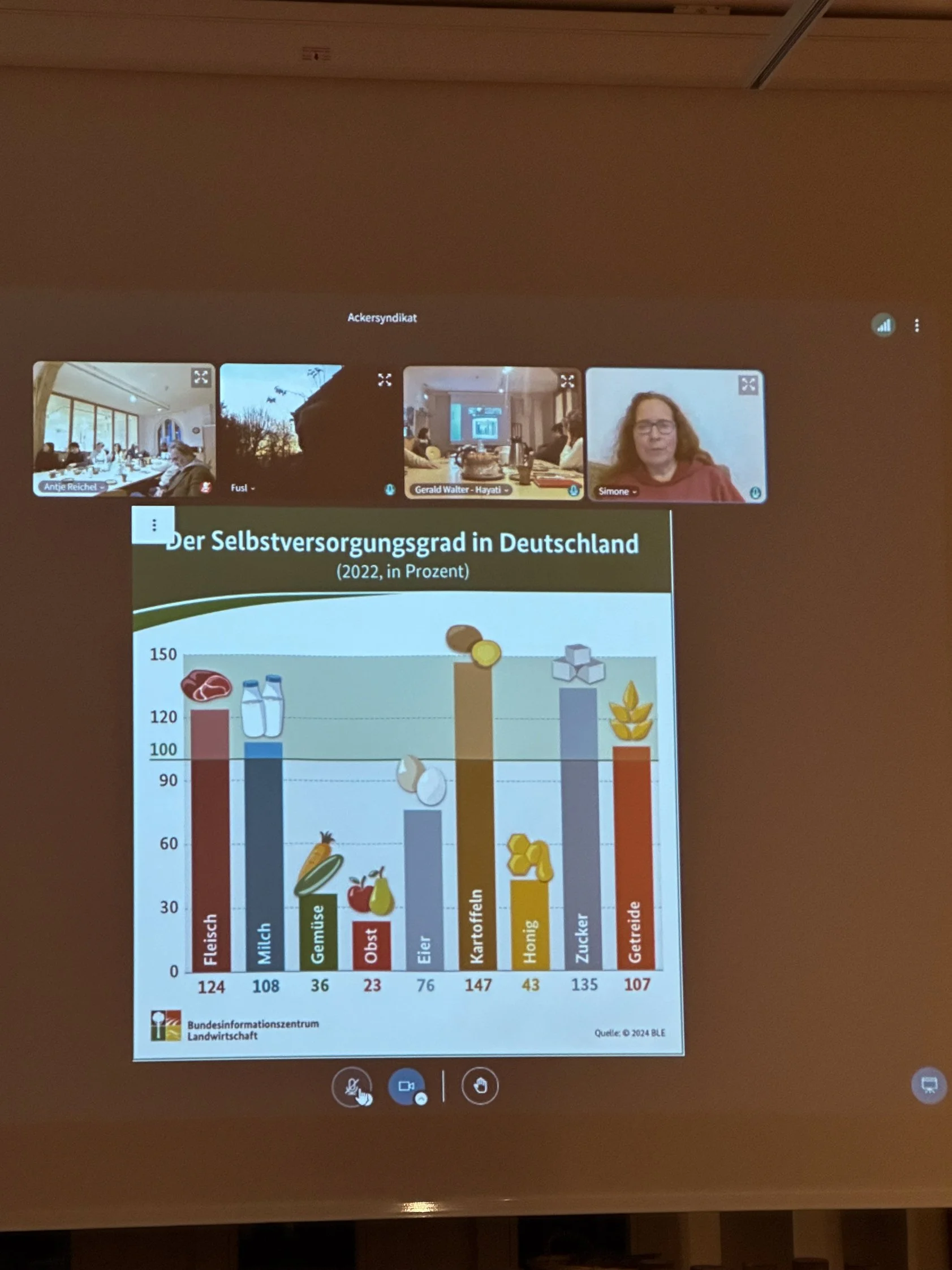
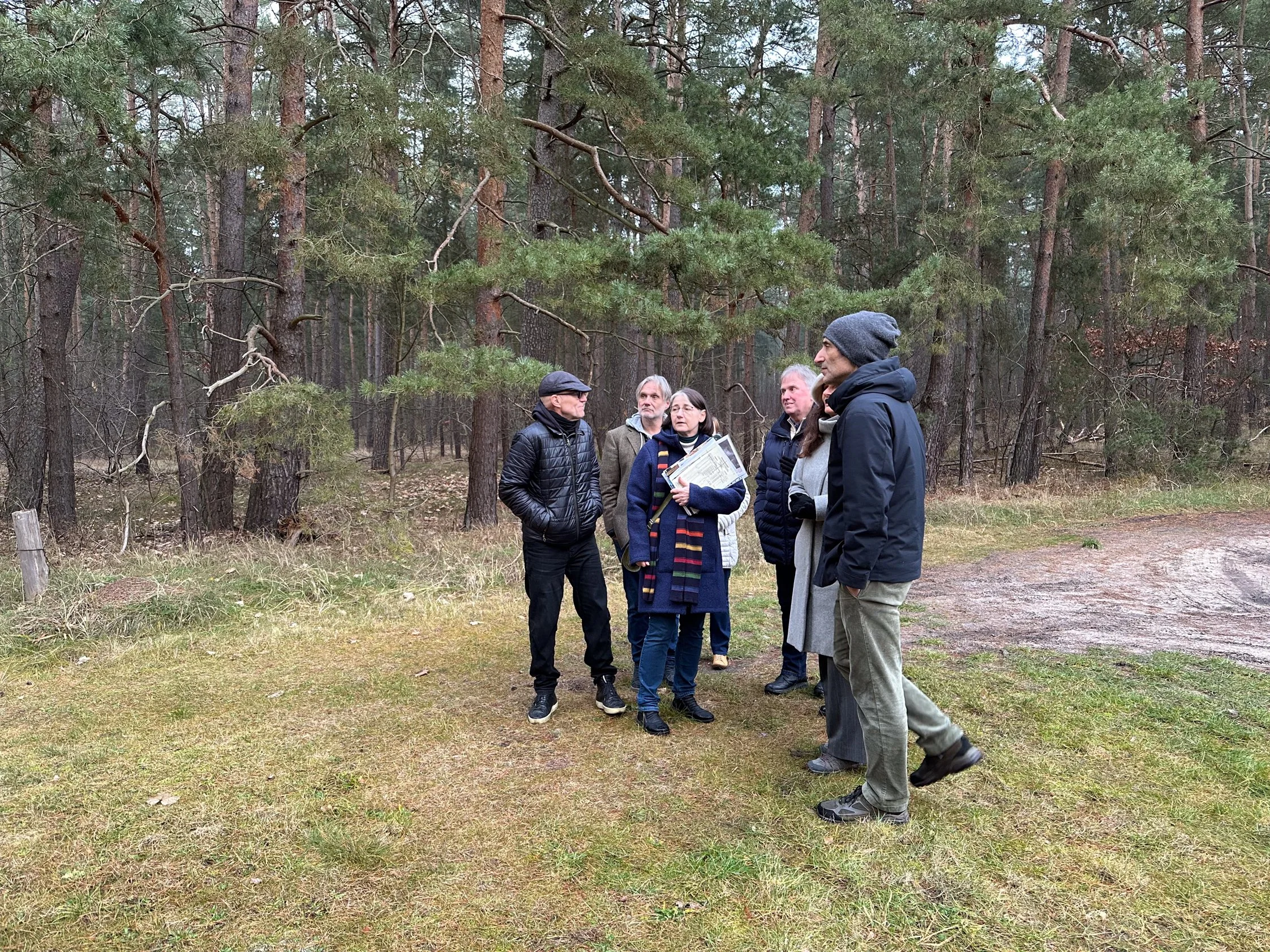
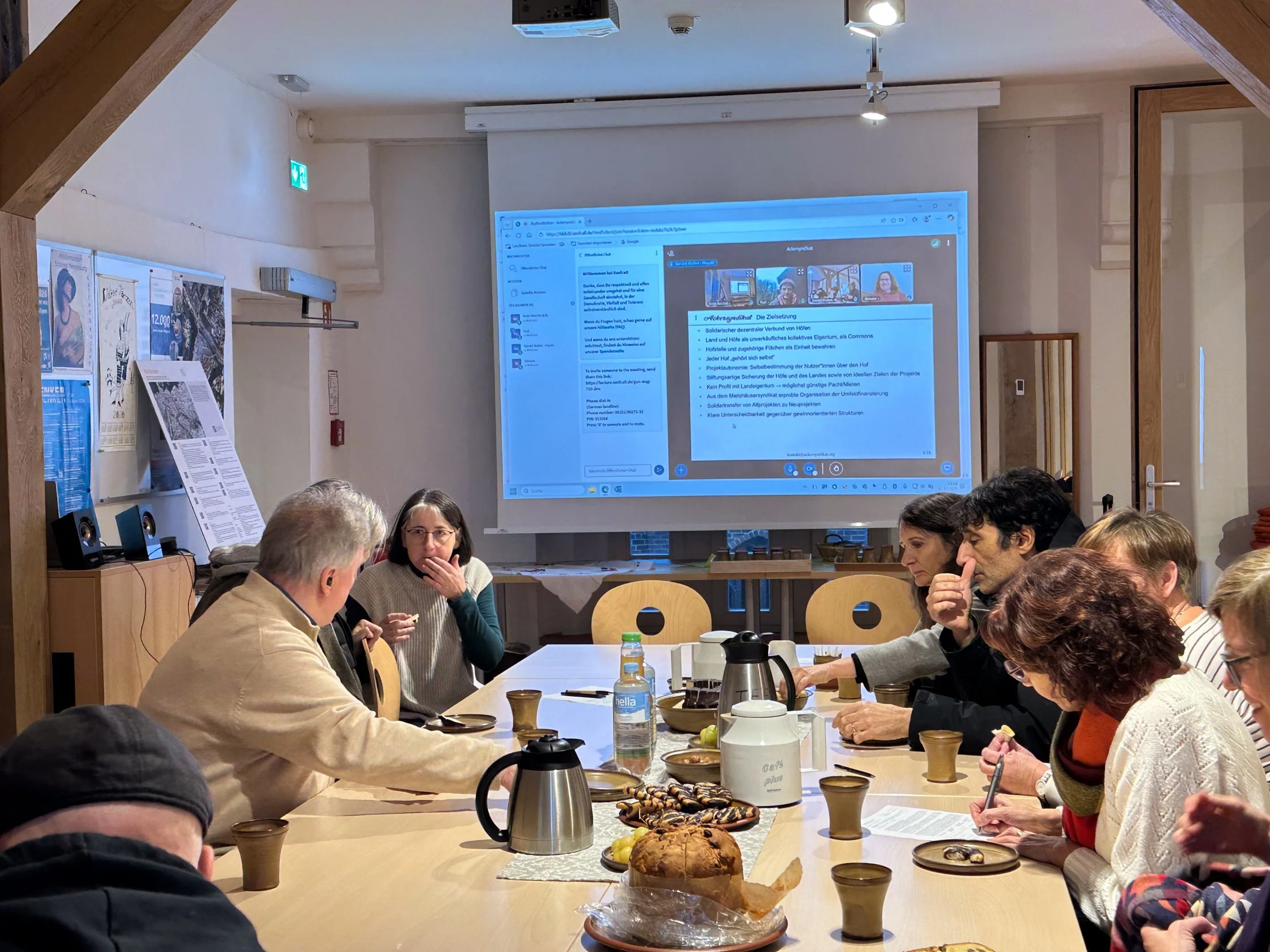
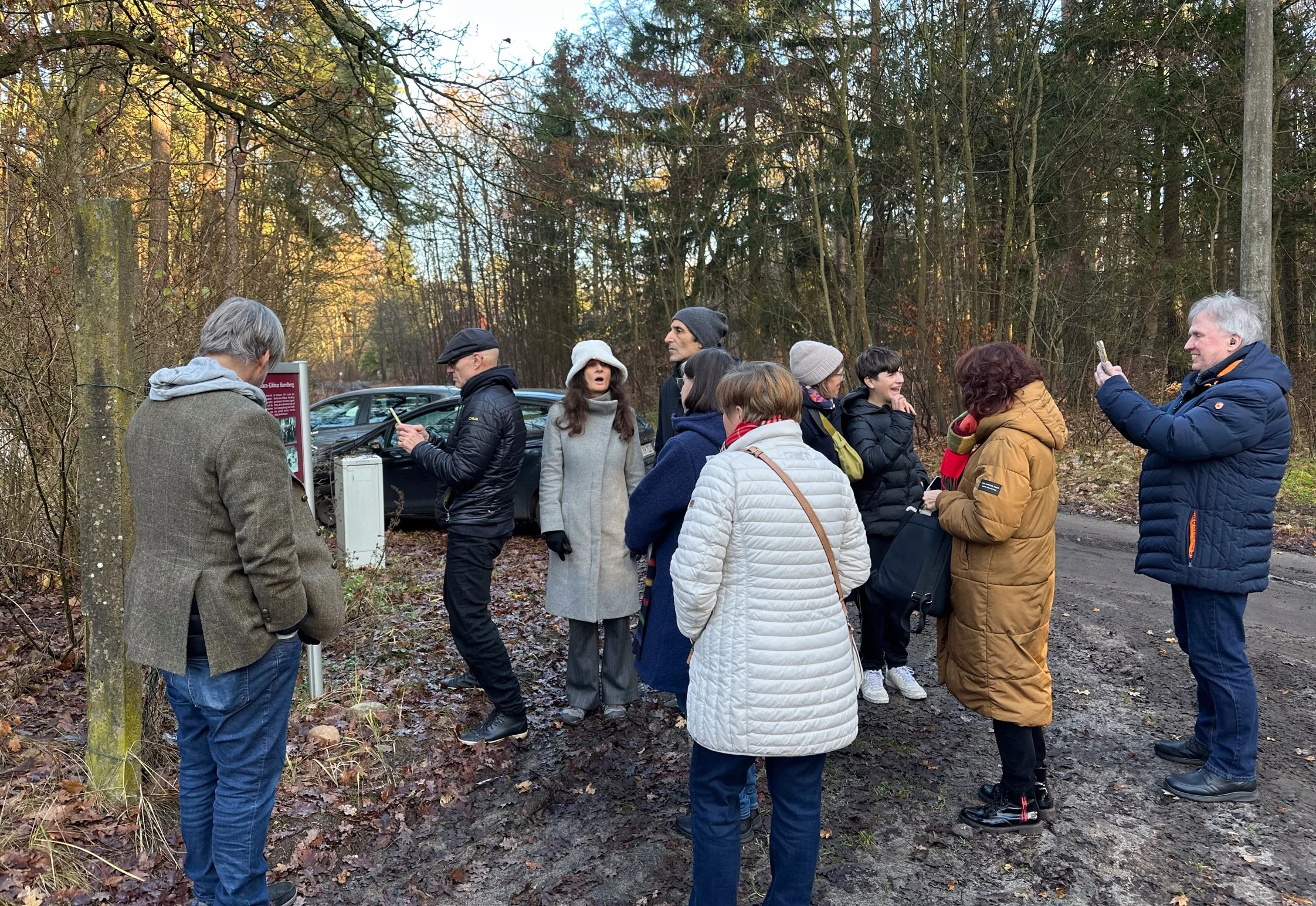
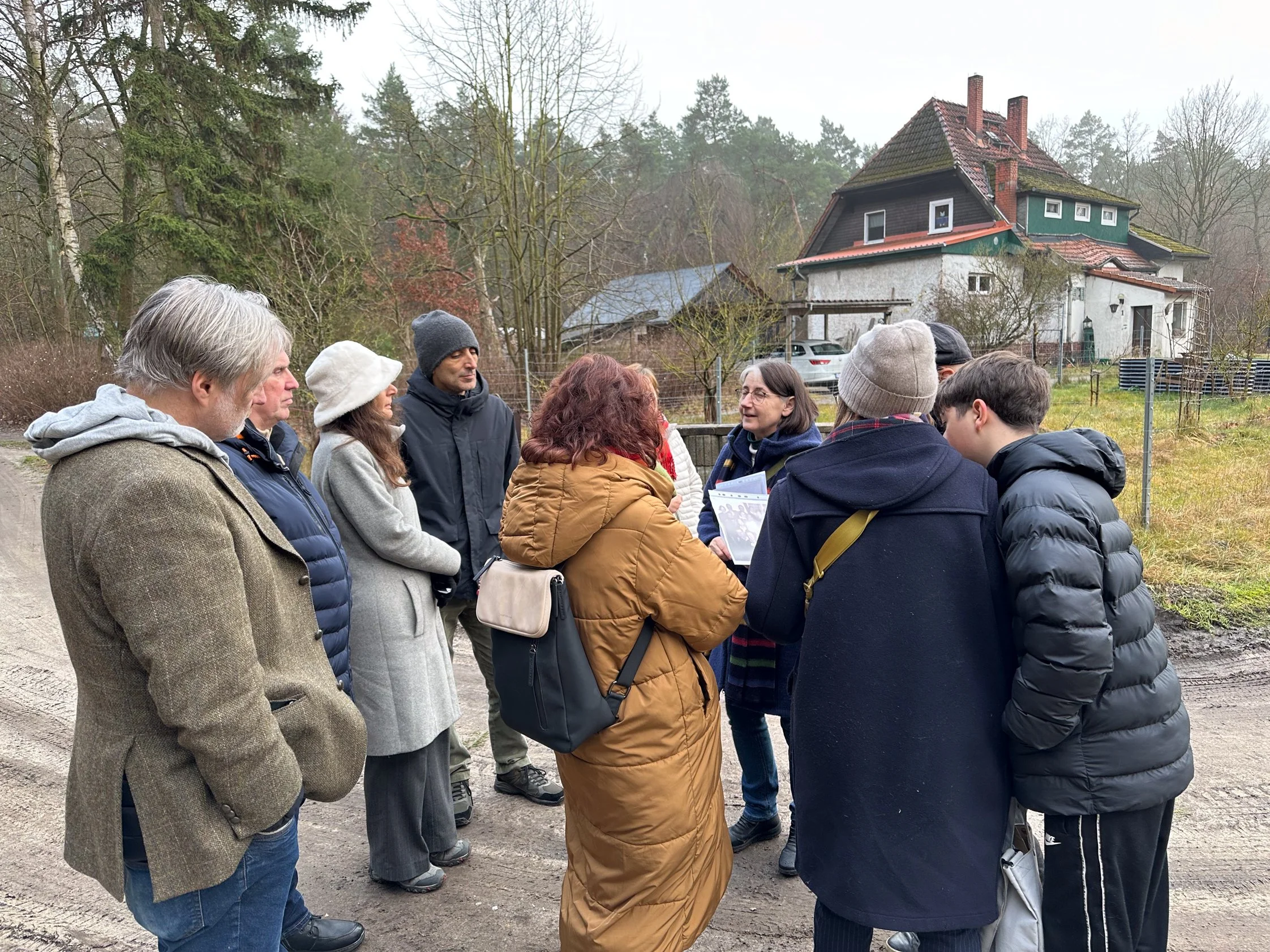
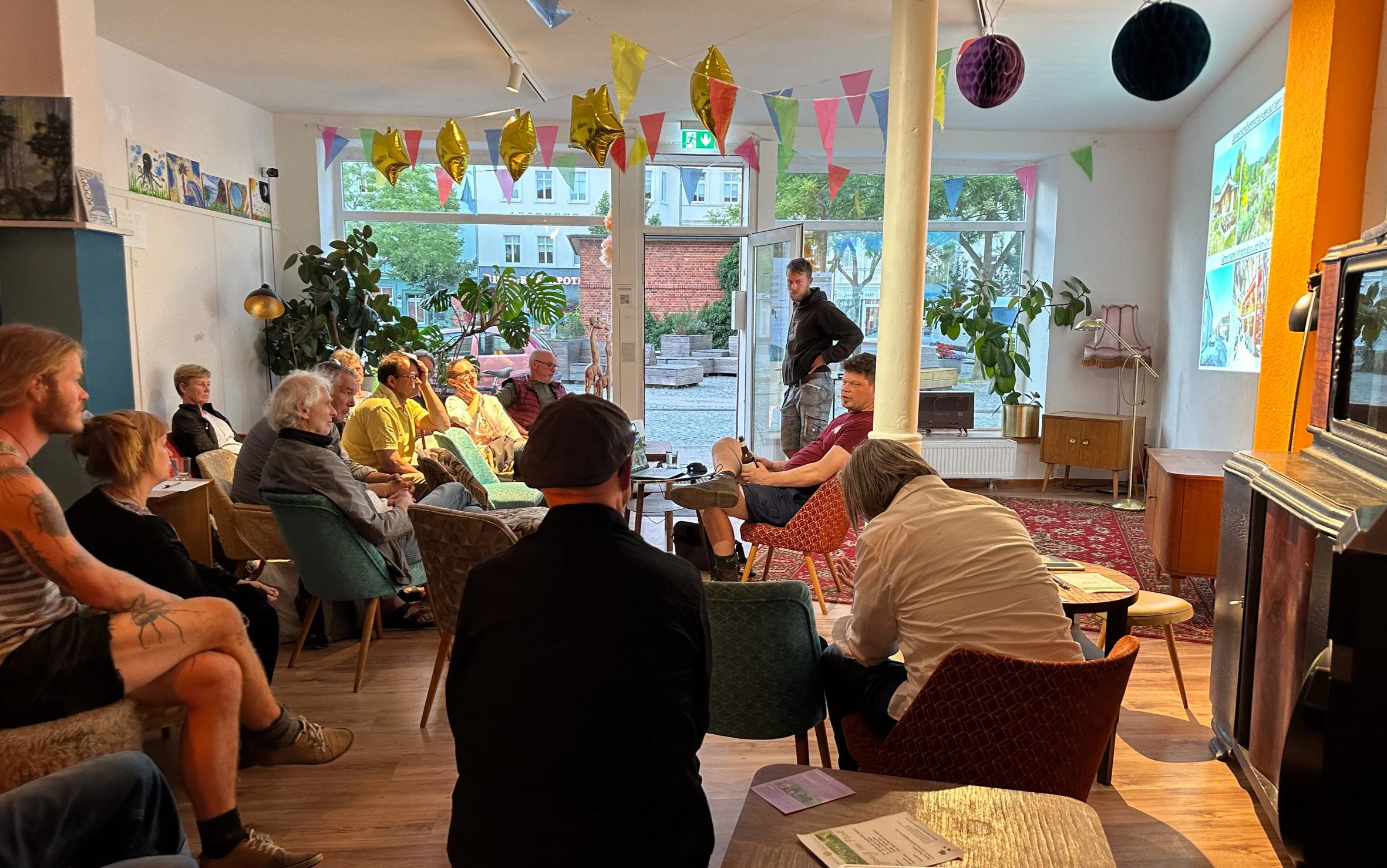
Wir haben fünf Veranstaltungen in Havelberg, Wittenberge und Berlin, z.T. im Rahmen unserer UTOPIENALE IV (www.utopienale.org), durchgeführt. Zum Abschluss haben wir den Ort des ehemaligen Hachschara-Kibbuz nordöstlich von Havelberg besucht und anschließend eine Online- und Offline-Diskussion zum Thema “Gemeineigentum - Commons, Kibbuz/Hachschara und Solidarische Landwirtschaft (SoLawi)” im Prignitzmuseum geführt. In unserem fair – Magazin für Kunst & Architektur (Wien/Berlin, www.fairarts.org) bildet das Projekt die Grundlage eines breiten Diskurses zu neuen (thr)utopischen Konzepten der Transformation.
(1) Elhacham, E., Ben-Uri, L., Grozovski, J., et al. Global human-made mass exceeds all living biomass. Nature 588, 442–444 (2020) www.nature.com/articles/s41586-020-3010-5
(3) www.huffingtonpost.co.uk/rupert-read/thrutopia-why-neither-dys_b_18372090.html
(4) www.aeon.co/essays/is-civil-disobedience-a-moral-obligation-in-a-time-of-climate-crisis
* A project by Hayati e.V. (Leipzig/Havelberg) & Old School ICA (Berlin/Havelberg) supported by Bundesministerium für Familie, Senioren, Frauen und Jugend via the federal programme „Demokratie Leben!“